TINY MANIFESTO
1.1) The festival has begun.
1.2) The festival has always-already begun.
1.3) The festival begins before it is envisioned, is built from buried potentials implicit and immanent within the artistic landscape of Ōtautahi and Aotearoa more broadly.
1.4) The vision of the festival grows from what is always-already present in te whenua, te ao, Te Tiriti and whakaaro across te motu.
1.5) The festival vision is curated based on the unearthing of this that is always-already present.
1.6) The festival vision is contingent and can be changed at any time through its relationship to artists.
2.1) The festival is always in progress.
2.2) The parameters of the festival can change at any time to meet need.
2.3) The fest shifts its model in response to place and context - including the political, economical, local and global.
2.4) Tiny Fest is a festival and more than festival, set in a constellation of projects and event dispersed, and collated across the temporal as well as spatial domain, meeting the needs of a dispersed arts community with diverse and equally dispersed needs.
3.1) The curation of the festival itself is progressive and iterative.
3.2) The festival is curated by a revolving team of curators who acknowledge the already-present and invisible festival potential across Aotearoa.
3.2.1) In early festival iterations, invitations to artists were made primarily by former Artistic Director Julia Harvie. In 2022, Tiny Fest invited Holly Chappell-Eason and Juanita Hepi to work with the Tiny Fest Artistic Director to create a curatorial team. For Tiny Fest 2024 Janaína Moraes came on board as the new Artistic Director, putting together a wide and diverse team comprising of Maryam Bagheri Nesami, Sean Curham, Josiah Morgan and Gab Stoddard to collaborate as a curatorial panel who were dedicated to fostering an accessible programme, embracing and reaching out for non-dominant/marginalized bodies of practice. Together, they devised a coherent call out and selected panel criteria, plus creating a list of artists they would like to approach for Tiny Fest 2024. In 2025/6 the team welcomes Josiah as our Creative Producer and, together with Janaína leads the new Curatorial Panel, now composed by Nes Karakia-Gray and Carol Brown. The Curatorial Team supports the Artistic Director to realize material (and immaterial) affordance and capacities for the business plan.
3.3) The curatorial team create space for mana kōrero, mana ao tūroa, and mana tāngata, echoing the festival structure itself.
3.4) The curatorial panel work to corral the festival into a visible form. This visible form involves callouts for proposed works to local, national, and international artists. It also involves invites for artists to participate in the festival.
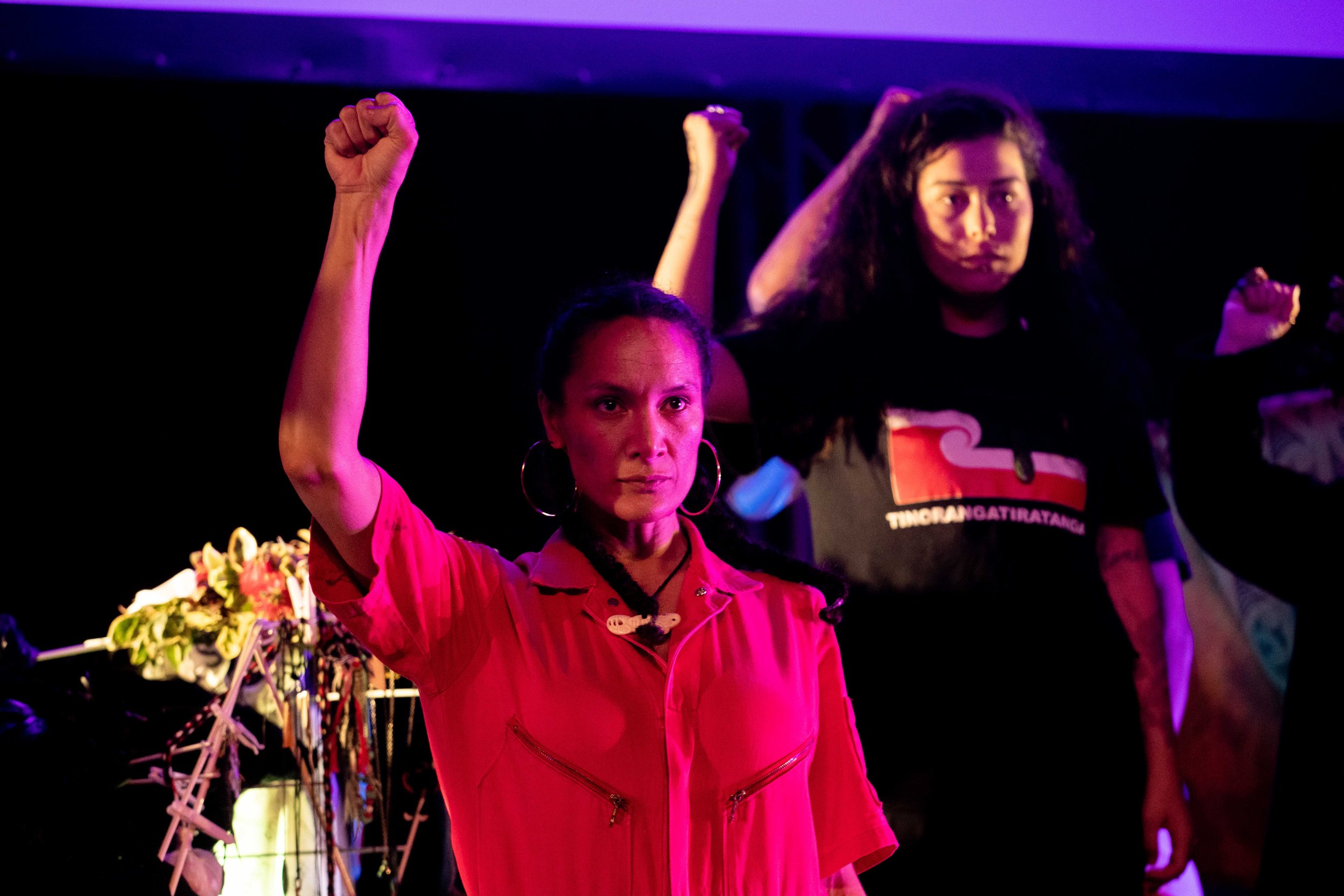
4.1) The festival views everyone, including audiences, as artists.
4.2) The festival works to redefine the relationship and complicity between creator and audience. It views art-making as porous, and acknowledges the audience as autonomous agents.
4.3) In acknowledging the audience’s agency, Tiny Fest strives to provide a comfortable environment for non-normative ways of engaging. With distribution not only around the boundaries of a dance/performance festival but also in how our understanding of the location is fragmented and diffracted in time and place, we have imagined our presence as a nomadic festival.
4.4) Tiny Fest encourages audience response. Each iteration of the festival to date has included an artistic response programme, in which Ōtautahi artists who are not part of the Tiny Fest programme itself receive free tickets in exchange for producing artwork in response to the programmed festival works. Artistic responders in the past have included Josiah Morgan (curatorial lead for the 2026 festival iteration), Claudia Jardine, FIKA, Naomi Van Den Broek, Melanie McKerchar, and more.
4.5) By encouraging audience response, Tiny Fest contributes to the understanding of the festival as a dispersed process. The festival is captured in archival documentation across disciplines, publications, art-forms and areas of the country. This ultimately contributes to the conclusion that:
5.1) The festival is never-ending.
5.2) The festival does not ‘stop’ merely when the weekend stops or when the money runs out.
5.3) The festival is comprised of its immanent potential.
5.4) The festival can always be resurrected.
5.5) The festival can always be ongoing.
5.6) The festival can emerge or disappear at any time.

6.1) The festival finds a new home in each iteration.
6.2) Each iteration of the festival takes place in a new environment. Environments to date have included: COCA, Christchurch Art Gallery, Christchurch Town Hall and Tūranga.
6.3) Each new home for the festival allows the festival to embody new potentials and respond to new artistic presences.
7.1) The festival is by, and for, artists.
7.2) Utilizing the definition of ‘artists’ outlined in 4.1-4.5, Tiny Fest is a festival by and for artists.
7.3) Therefore, Tiny Fest operates as a festival by and for everybody.